

This content is for informational purposes only and does not constitute medical advice. Please consult with a licensed podiatrist for a personalized evaluation and treatment plan. Individual results may vary.
A diabetic foot is a clinical term for a range of pathologies affecting the lower extremities in individuals with diabetes, primarily caused by prolonged hyperglycemia. This condition typically involves peripheral neuropathy (nerve damage) and peripheral arterial disease (reduced blood flow), which significantly impair the body’s ability to detect and heal injuries. Medical intervention is required immediately if a patient observes persistent redness, localized heat, new swelling, unusual odor, or any skin breakage that fails to show signs of closure within 24 hours. Because diabetes suppresses the inflammatory response and dull pain perception, early professional diagnostic assessment is the only reliable method to prevent the progression from a minor irritation to a limb-threatening emergency.
Comprehensive diagnostic evaluations and advanced limb-salvage protocols for patients in the Los Angeles area are available through the expert services of Dr. Arkady Kaplansky.
The Clinical Pathology: How Diabetes Impacts Foot Health
Simultaneously, the nervous system undergoes significant degradation. This interference prevents vital sensory signals from reaching the brain. When the feet lose the ability to sense mechanical stress, friction, or extreme temperatures, the body’s primary defense mechanism is neutralized. A minor abrasion or a small pebble inside a shoe can remain undetected for days, allowing an infection to penetrate deep into the subcutaneous tissue or the bone.
Identifying Progressive Diabetic Neuropathy Symptoms
Clinical indicators frequently include:
- Paresthesia: Consistent sensations of tingling or “pins and needles” in the toes.
- Hyperesthesia: An exaggerated response to touch, where the weight of a bedsheet causes significant distress.
- Thermal Insensitivity: An inability to distinguish between hot and cold water, leading to accidental burns.
- Loss of Proprioception: Difficulty maintaining balance because the brain lacks accurate data regarding the position of the feet relative to the ground.
- Muscle Atrophy: Weakness in the small muscles of the foot, leading to changes in the arch and toe alignment.
While some patients experience a total loss of feeling, others suffer from debilitating diabetic foot pain. This neuropathic pain is often described as “stabbing,” “burning,” or “electrical” and typically intensifies during the night, leading to chronic sleep deprivation and decreased quality of life.
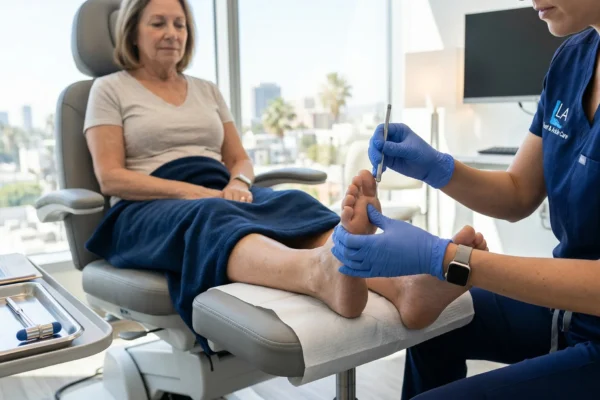
Clinical Stages of Neuropathic Progression
| Stage | Sensory Experience | Clinical Risk Level |
|---|---|---|
| Early | Intermittent tingling or mild burning sensations | Low – Managed via glucose stabilization |
| Intermediate | Frequent numbness and loss of vibratory sense | Moderate – Protective footwear required |
| Advanced | Complete anesthesia (total loss of feeling) | High – Severe risk for “silent” ulcers |
| Critical | Structural changes and visible muscle wasting | Severe – Risk of Charcot foot or amputation |
The Structural Crisis: Charcot Foot and Bone Collapse
The lack of pain feedback leads to a cycle of repeated injury, causing the bones to fragment and the joints to collapse. The most common sign of this condition is a “rocker-bottom” appearance, where the arch of the foot disappears and the middle of the foot bulges outward.
Warning Signs of Charcot Foot
- Localized Heat: The affected foot feels significantly warmer than the contralateral limb.
- Persistent Edema: Swelling that does not resolve with rest or elevation.
- Erythema: Redness of the skin without a visible wound or trauma.
- Bone Displacement: The foot begins to look wider, shorter, or visibly deformed.
Skin and Nail Complications in Diabetic Patients
Standard skin and nail issues become high-risk events:
- Plantar Warts: Viral lesions can be difficult to treat because the surrounding skin is fragile and prone to ulceration.
- Fungal Infections: Thick, fungal nails can press into the nail bed, causing “silent” subungual ulcers.
- Ingrown Nails: A standard ingrown nail can quickly evolve into a systemic infection if a patient attempts “bathroom surgery” without sterile tools.
Clinical Pedicure vs. Standard Salon Pedicure
| Feature | Standard Salon Pedicure | Clinical Diabetic Pedicure |
|---|---|---|
| Primary Goal | Aesthetics and relaxation | Infection prevention and foot health |
| Tools | Often sanitized, rarely autoclaved | Surgical-grade, sterile instruments |
| Specialist | Licensed nail technician | Podiatrist or trained medical assistant |
| Risk Factors | High risk of nicks and cross-infection | Sterile environment with medical oversight |
| Skin Care | Fragranced lotions and soaking | Therapeutic diabetic foot care products |
Advanced Treatment Technologies and Clinical Services
1. Remy Laser Pain Treatment and Wart Removal
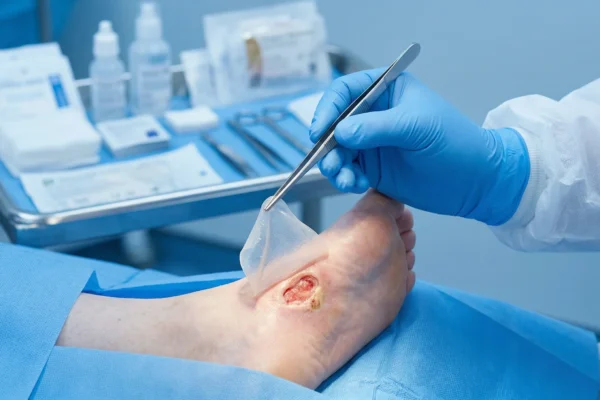
2. Platinum Biologics and Advanced Wound Care
3. Custom Foot Orthotics and Radiesse Filler
- Foot Orthotics: Prescription-grade inserts are engineered to redistribute weight away from “hot spots” on the sole.
- Radiesse Filler for Feet: For patients with fat pad atrophy (thinning of the natural cushion), Radiesse is injected into the ball of the foot to provide an internal “liquid cushion,” protecting the metatarsal bones from pressure.
4. Onyfix and Cool Touch Varia Laser
- Onyfix Ingrown Toenail Treatment: A non-invasive system that uses a composite resin to retrain the nail to grow straight, avoiding the need for surgical incisions.
- Cool Touch Varia Laser: A specialized laser that eliminates nail fungus (onychomycosis) without the systemic side effects associated with oral antifungal medications.
5. Foot and Ankle Surgery
Long-Term Maintenance and Prevention Protocol
Daily Podiatric Maintenance Checklist
| Action | Frequency | Clinical Purpose |
|---|---|---|
| Visual Inspection | Every morning and evening | Identify blisters or redness before they ulcerate |
| Cleaning and Drying | Daily | Prevent fungal growth between the toes |
| Moisturizing | Twice daily | Prevent fissures (do not apply between toes) |
| Shoe Inspection | Before every use | Ensure no pebbles or rough linings are present |
| Professional Exam | Every 3-6 months | Evaluate circulation and nerve health |
Frequently Asked Questions
What are the earliest warning signs of a diabetic foot problem?
Why is specialized skin care necessary for dry feet and diabetes?
How can chronic diabetic foot pain be managed without medication?
What is the benefit of Platinum Biologics for non-healing wounds?
References
- Mayo Clinic — https://www.mayoclinic.org/diseases-conditions/diabetic-neuropathy/symptoms-causes/syc-20371580
- NIDDK — https://www.niddk.nih.gov/health-information/diabetes/overview/preventing-problems/foot-problems
- American Podiatric Medical Association — https://www.apma.org/Patients/FootHealth.cfm?ItemNumber=981
- Cleveland Clinic — https://my.clevelandclinic.org/health/diseases/15846-charcot-foot
- Cleveland Clinic — https://my.clevelandclinic.org/health/diseases/24434-fat-pad-atrophy