

This content is for informational purposes only and does not constitute medical advice. Please consult with a licensed podiatrist for a personalized evaluation and treatment plan. Individual results may vary.
A ganglion cyst is a non-cancerous, fluid-filled sac that typically develops near the joints or tendons of the foot and ankle. These masses occur when synovial fluid—the natural lubricant for joints—leaks and accumulates in a localized lump. A patient should seek a medical evaluation if the cyst becomes painful, limits the range of motion in the foot or ankle, or causes discomfort when wearing standard footwear. While many of these growths are asymptomatic, a professional diagnosis is necessary to rule out more serious conditions and to determine whether conservative management or surgical intervention is required.
Patients in the Los Angeles area experiencing persistent foot lumps or joint discomfort can access specialized diagnostic care and advanced treatment through Arkady Kaplansky, DPM, who focuses on restoring mobility and comfort through modern podiatric techniques.
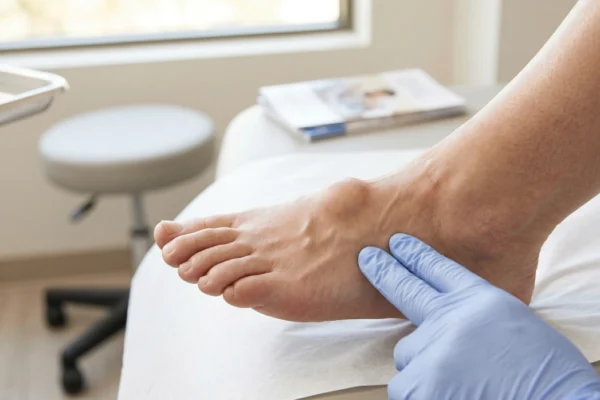
Identifying Ganglion Cyst Signs and Symptoms in the Lower Extremities
Commonly reported symptoms include:
- Localized Swelling: A visible, round, or oval mass that may appear suddenly or grow gradually over several months.
- Dull Aching or Tenderness: If the cyst is located near a nerve, it can cause persistent pain, tingling, or a “pins and needles” sensation.
- Skin Irritation: In the Los Angeles climate, where active lifestyles are common, friction between the cyst and footwear can lead to redness, inflammation, or localized skin breakdown.
- Functional Obstruction: A cyst near a joint, such as the ankle, may physically prevent the joint from moving through its full range, affecting a patient’s gait or ability to exercise.
While the term bible cyst on wrist or g cyst on wrist is frequently used in general medical searches, these same fluid-filled structures are equally prevalent in the feet. The mechanics of the foot, which involve significant weight-bearing and repetitive motion, often make foot-based ganglions more symptomatic than a cyst wrist joint due to constant pressure from shoes and the ground.
Differential Diagnosis: Comparing Foot Lumps
| Characteristic | Ganglion Cyst | Lipoma (Fatty Tumor) | Morton’s Neuroma |
|---|---|---|---|
| Consistency | Firm, rubbery, or spongy | Soft and doughy | Not visible (internal) |
| Mobility | Slightly mobile under the skin | Very mobile | Fixed between bones |
| Fluid Presence | Filled with synovial fluid | Solid fat tissue | Thickened nerve tissue |
| Pain Level | Aches if pressing on a nerve | Rarely painful | Sharp, burning, or “electric” |
| Transillumination | Light passes through (Glows) | Light does not pass through | N/A |
Causes and Development of the Ganglion Lump
In the foot, repetitive stress from running, jumping, or wearing ill-fitting shoes can aggravate the joint capsule. This explains why athletes and individuals with high-impact occupations are often more susceptible to developing these growths. Although a wrist ganglion treatment might focus on repetitive typing or lifting, foot treatments must account for the complex biomechanics of weight distribution and the unique stressors placed on the lower extremities during daily ambulation.
Ganglion Treatment: Professional Clinical Options
Conservative Management and Pressure Relief
- Foot Orthotics: Custom-molded shoe inserts are a critical component of non-surgical care. By correcting the alignment of the foot and stabilizing the midfoot joints, Foot Orthotics reduce the mechanical stress and friction that cause the cyst to enlarge. This is particularly effective for ganglions located on the dorsal (top) aspect of the foot where shoe pressure is highest.
- Aspiration: This procedure involves numbing the area and using a sterile needle to drain the fluid. While this provides immediate relief and reduces the size of the lump, the recurrence rate is relatively high because the “stalk” or root of the cyst remains intact.
- Remy Laser Pain Treatment: For patients experiencing chronic inflammation or nerve-related pain due to the cyst, advanced laser therapy offers a non-invasive solution. The Remy Laser Pain Treatment utilizes specific wavelengths of light to penetrate deep into the tissue, stimulating cellular repair, improving local circulation, and reducing the inflammatory markers that cause discomfort.
Surgical Intervention: Foot and Ankle Surgery
During the surgery, the podiatric surgeon makes a small incision over the mass. The goal is not just to remove the visible sac, but to trace the cyst back to its origin—the joint capsule or tendon sheath. By removing the stalk and a small portion of the surrounding tissue, the surgeon effectively closes the “valve,” which significantly reduces the chance of the cyst returning.
Success Rates: Aspiration vs. Surgery
| Metric | Needle Aspiration | Surgical Excision |
|---|---|---|
| Procedure Time | 5–10 minutes | 30–45 minutes |
| Recurrence Rate | 50% – 80% | 5% – 15% |
| Recovery Period | Immediate | 2 – 3 weeks |
| Anesthesia | Local only | Local with Sedation |
| Best For | Initial diagnosis / Temporary relief | Permanent resolution / Painful cysts |
Advanced Recovery and Post-Operative Care
Platinum Biologics
Specialized Wound Care
While a ganglion cyst is benign, its presence can significantly impact a patient’s quality of life, especially when it interferes with walking, exercise, or the ability to wear favorite shoes. Understanding ganglion cyst how to treat begins with recognizing that a “one size fits all” approach is rarely effective. Whether a patient requires the biomechanical support of Foot Orthotics, the inflammatory relief of the Remy Laser, or the definitive solution of Foot and Ankle Surgery, professional intervention is key to long-term health.
Diagnostic accuracy is paramount, as other types of tumors or inflammatory conditions can occasionally mimic the appearance of a ganglion. By consulting a specialist who utilizes the latest technologies—from Platinum Biologics to comprehensive Wound Care—patients can ensure their foot health is restored with the highest standard of medical excellence.
Frequently Asked Questions
What are the first signs of a ganglion cyst on the foot?
Can a ``bible cyst`` be popped at home?
Will a ganglion cyst go away on its own without treatment?
What is the most effective ganglion treatment for a painful lump?
Is surgery the only way to permanently remove a ganglion cyst?
How long is the recovery after foot and ankle surgery for a cyst?
How can custom orthotics help with a cyst on the foot?
References
- American Academy of Orthopaedic Surgeons — https://orthoinfo.aaos.org/en/diseases–conditions/ganglion-cyst/
- Mayo Clinic — https://www.mayoclinic.org/diseases-conditions/ganglion-cyst/symptoms-causes/syc-20351156
- Cleveland Clinic — https://my.clevelandclinic.org/health/diseases/15554-ganglion-cysts
- National Center for Biotechnology Information (NCBI) — https://www.ncbi.nlm.nih.gov/books/NBK470588/