

This content is for informational purposes only and does not constitute medical advice. Please consult with a licensed podiatrist for a personalized evaluation and treatment plan. Individual results may vary.
Pediatric foot care involves the specialized medical monitoring and treatment of a child’s lower extremities during the critical stages of physical development. While many variations in gait are a normal part of growth, professional intervention is required if a child experiences persistent pain, functional limitations, or asymmetrical walking patterns that do not resolve by age eight. Early assessment by a specialist ensures that structural issues are addressed while the bones and ligaments are still malleable, preventing chronic mobility challenges in adulthood. Identifying developmental deviations early is the most effective way to ensure a stable foundation for a child’s future health.
Expert evaluation and advanced pediatric treatments are available in Los Angeles through Dr. Arkady Kaplansky, who specializes in restoring proper alignment and function for young patients.

The Biological Stages of Foot Development
The progression of foot development follows a predictable timeline, though individual variations exist. Understanding these milestones helps distinguish between natural growth phases and conditions that necessitate a visit to a pediatric podiatrist.
Pediatric Podiatry Developmental Milestones
| Age Group | Physical Structure and Gait Characteristics | Clinical Focus Areas |
|---|---|---|
| 0-12 Months | Highly flexible bones; feet appear flat due to natural fat pads. | Monitoring for congenital issues like Clubfoot or Metatarsus Adductus. |
| 1-3 Years | Wide-based gait; prominent in-toeing or out-toeing is common. | Assessing the transition to independent walking and balance. |
| 4-7 Years | The medial arch begins to lift and become visible. | Performing a flat feet check and monitoring for growth plate pain. |
| 8-12 Years | Gait stabilizes; adult-like walking patterns emerge. | Managing sports injuries, heel pain, and skin conditions like warts. |
| 13-18 Years | Ossification nears completion; the foot reaches adult size. | Final structural corrections and high-impact athletic support. |
Understanding In-toeing and Out-toeing
Clinical Overview of Pigeon Feet
- Metatarsus Adductus: A curvature in the front half of the foot itself. This is often visible from birth and may require stretching or serial casting if the foot is rigid.
- Internal Tibial Torsion: An inward twist of the tibia (shin bone). This is most noticeable when the child begins to walk and generally corrects itself as the child grows and the bone untwists naturally.
- Femoral Anteversion: An inward rotation of the femur (thigh bone). This is most apparent in children aged three to eight. A common sign is the “W-sitting” position, where the child sits with their knees forward and feet flared out to the sides.
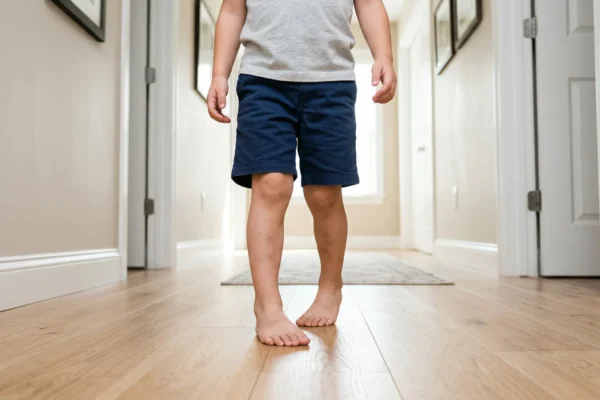
Clinical Overview of Duck Footedness
The Clinical Importance of a Flat Feet Check
A pediatric podiatrist differentiates between two types of flat feet to determine the necessary course of action:
- Flexible Flatfoot: The arch is visible when the child is sitting or standing on their toes but disappears when standing flat. This is generally considered a normal developmental variation and rarely requires treatment unless the child experiences pain or fatigue.
- Rigid Flatfoot: The arch is absent regardless of the foot’s position. This is a more serious condition often caused by tarsal coalition (where two bones in the foot are fused together). Rigid flatfoot requires professional intervention to prevent permanent disability.
Pediatric Podiatrist Shoe Recommendations
Essential Criteria for Children's Shoes
| Shoe Feature | Requirement for Healthy Growth | Reason for Medical Recommendation |
|---|---|---|
| Heel Counter | Must be firm and non-compressible. | Stabilizes the heel bone and prevents excessive rolling. |
| Midsole | Should be rigid and resistant to twisting. | Provides support for the developing medial arch. |
| Toe Box | Flexible at the point where the toes bend. | Allows for natural propulsion during the walking cycle. |
| Sizing | 1/2 inch (thumb’s width) of space at the toes. | Prevents ingrown nails and allows for rapid growth spurts. |
| Materials | Leather, canvas, or breathable mesh. | Reduces moisture to prevent fungal infections and warts. |
Advanced Medical Technologies for Pediatric Foot Care
Non-Invasive Corrective Technologies
- Foot Orthotics: Custom-molded inserts are the primary treatment for symptomatic flat feet and gait abnormalities. They realign the foot to prevent secondary pain in the knees and lower back.
- Onyfix Ingrown Toenail Treatment: This is a pain-free nail correction system that uses a composite resin to guide the nail back to a natural shape. It is an ideal alternative for children who are anxious about needles or surgery.
Advanced Laser and Biologic Therapies
- Remy Laser Pain Treatment: A high-intensity laser used to treat inflammation in the growth plates (Sever’s Disease) or sports injuries. It accelerates cellular repair and reduces pain without the need for medication.
- Remy Laser Wart Treatment: Plantar warts are highly common in school-age children. This laser targets the blood supply of the wart, providing a faster and more reliable cure rate than traditional acids.
- Platinum Biologics: For severe tendon or ligament injuries in youth athletes, biologic injections can be used to stimulate the body’s natural healing response, reducing downtime from sports.
Surgical and Specialized Care
- Foot and Ankle Surgery: When conservative measures fail to correct rigid flatfoot or structural deformities, surgical intervention may be necessary to realign the bones and joints.
- Wound Care: Specialized pediatric wound management is essential for treating infected ingrown nails or providing post-surgical support to ensure proper healing without scarring.
Common Pathologies in Growing Feet
Sever's Disease (Calcaneal Apophysitis)
Pediatric Plantar Warts (Verrucae)
Proactive Care for Long-Term Mobility
A proactive flat feet check and adherence to pediatric podiatrist shoe recommendations can prevent the development of compensatory gait issues. For any concerns regarding pigeon feet, duck footedness, or persistent pain, a consultation with a specialist is the most reliable way to protect the integrity of a child’s foot development. Families in Los Angeles can easily coordinate specialized evaluations and follow-up care through the Doctor2me platform. Utilizing this streamlined service ensures that every child receives timely, expert attention to support a lifetime of healthy movement.
Frequently Asked Questions
Does a child need to see a pediatric podiatrist for flat feet?
Why are a child's toes pointing inward when they walk?
How is heel pain in active children treated?
What are the standard pediatric podiatrist shoe recommendations for toddlers?
Are plantar warts in children a cause for concern?
Is surgery common for pediatric foot conditions?
How often should a child's foot development be monitored?
References
- American Academy of Orthopaedic Surgeons (AAOS) — Intoeing – OrthoInfo – American Academy of Orthopaedic Surgeons
- American Podiatric Medical Association (APMA) —Today’s Podiatrist Keeps Kids Active – APMA MAIN
- American Orthopaedic Foot & Ankle Society (AOFAS) —Flatfoot Surgical Correction | Flatfoot Surgery Procedure & Recovery