

This content is for informational purposes only and does not constitute medical advice. Please consult with a licensed podiatrist for a personalized evaluation and treatment plan. Individual results may vary.
Morning heel pain is an acute, stabbing sensation caused by the sudden stretching of a shortened plantar fascia, whereas evening pain is a dull ache resulting from cumulative daily strain and muscle fatigue.
Distinguishing between these two presentation times allows clinicians to determine whether a patient requires overnight tissue elongation or daytime structural arch support. According to clinical guidelines from the Mayo Clinic, persistent discomfort lasting longer than a few weeks requires professional evaluation to prevent permanent tissue degeneration.
For comprehensive diagnostic evaluations and personalized treatment plans in Los Angeles, patients can visit the Dr. Arkady Kaplansky. His practice specializes in restoring pain-free mobility using evidence-based therapeutic protocols.
Why Does the Plantar Fascia Hurt More at Specific Times of Day?
The plantar fascia is a dense band of connective tissue that spans the sole of the foot, connecting the heel bone to the base of the toes. It plays a critical role in shock absorption and maintaining the structural integrity of the longitudinal arch during movement. Tracking the exact periods when the plantar fascia hurts provides critical insights into the underlying mechanical stresses affecting the foot.
The Biomechanics of a Foot Sore in the Morning
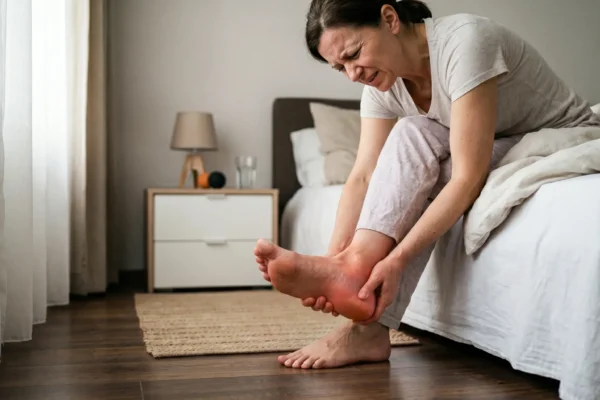
Taking the first steps out of bed forces the foot flat, causing an immediate, violent stretch of the contracted tissue. This sudden loading explains why heel pain that is worse in the morning occurs for the vast majority of patients. Clinical intake records frequently document complaints of heel pain in the morning when I wake up, pointing directly to this predictable cycle of overnight shortening and daytime tearing.
- The structural change begins with a sharp, localized shock centered directly under the medial calcaneal tubercle.
- A gradual loosening of the tissue typically occurs after five to ten minutes of continuous, low-impact walking.
- A secondary wave of stiffness often returns immediately following any extended period of daytime sitting or resting.
The Mechanics Behind a Sore Plantar Fascia in the Evening
This cumulative workload leads to a deep, throbbing ache by the afternoon or evening. When the foot aches in the morning, it indicates a lack of elasticity, but evening discomfort signifies that the tissue is severely overworked. Individuals who notice a sore heel in the morning often experience this late-day decline as well due to continuous uncompensated strain.
| Daily Activity Type | Impact on Fascial Tissue | Associated Symptom Pattern |
|---|---|---|
| Prolonged static standing | Causes continuous, unyielding downward hydrostatic pressure on the heel | Induces a deep, burning sensation late in the afternoon |
| High-impact road running | Generates repetitive tensile stress equal to several times body weight | Causes sharp, localized micro-tearing during or after exercise |
| Walking barefoot on hardwood | Eliminates all external arch support, forcing maximum fascial extension | Accelerates the development of acute evening throbbing |
What Do Current Clinical Statistics Reveal About Calcaneal Pain?
| Patient Category | Clinical Statistical Metric (2025-2026 Data) | Primary Anatomical Impact |
|---|---|---|
| Annual United States Cases | Approximately 2,000,000 individuals treated | Chronic heel inflammation and mobility limitations |
| Peak Age Distribution | 40 to 60 years of age represents 83% of cases | Progressive loss of natural arch elasticity |
| High-Impact Athletes | 10% to 25% of all persistent running injuries | Repetitive micro-tearing at the calcaneal insertion |
| Occupational Risk Groups | 65% of cases involve prolonged standing on hard floors | Accelerated intrinsic muscle fatigue and arch strain |
Research published by the Harvard Health Publishing shows that a high body mass index increases tissue strain exponentially. A body mass index greater than 30 correlates with a sixfold increase in the likelihood of developing chronic plantar symptoms. Additionally, structural variations such as flat feet or unusually high arches accelerate muscle fatigue, intensifying evening throbbing.
- Repetitive occupational standing on unyielding concrete or tile floors without anti-fatigue mats.
- Rapid increases in weekly running mileage or sudden transitions to high-intensity interval training.
- The regular use of worn-out footwear lacking rigid internal shanks or proper midfoot contouring.
How Do Targeted Protocols Relieve Severe Plantar Fasciitis Symptoms?
Morning Interventions to Reduce Initial Stretching Shock
- Nocturnal Splinting: Wearing a rigid or specialized sock night splint holds the ankle joint in a neutral 90-degree position overnight. This mechanical positioning prevents the foot from dropping into plantar flexion, ensuring the tissue heals in an elongated state.
- Pre-Step Mobilization: Before placing feet on the floor, patients should perform passive stretching exercises. Sitting on the edge of the bed and manually pulling the toes back toward the shin for 30 seconds helps slowly introduce tension to the tissue, preventing sudden shock.
- Bedside Supportive Footwear: Keeping rigid-soled, supportive house shoes immediately next to the bed prevents the arch from collapsing during the first trip across the room. Barefoot walking must be strictly avoided to protect the healing fibers.
Evening Recovery Strategies to Eliminate Cumulative Inflammation
- Local Cryotherapy: Rolling the affected arch over a frozen water bottle for 15 to 20 minutes at the end of the day constricts blood vessels. This process flushes out cellular waste products and reduces deep tissue swelling around the heel insertion.
- Lower Extremity Elevation: Raising the feet above heart level for 20 minutes reduces gravity-induced swelling in the lower limbs. This practice relieves hydrostatic pressure on the sensitive heel structures.
- Contrast Bath Therapy: Alternating between warm water for five minutes and cold water for two minutes stimulates arterial blood flow. This specialized circulation pattern accelerates recovery in overworked tissues after a long day of standing.
Which Professional Interventions Provide Long-Term Structural Relief?
| Advanced Clinical Modality | Biomechanical Mechanism of Action | Expected Therapeutic Outcome |
|---|---|---|
| Extracorporeal Shockwave Therapy | Delivers high-energy acoustic sound waves to the calcaneal insertion | Triggers neovascularization and restarts the biological healing process |
| Platelet-Rich Plasma Therapy | Injects concentrated autologous growth factors under ultrasound guidance | Biological repair matrix accelerates recovery and replaces degraded fibers |
| Custom Biomechanical Orthotics | Controls the subtalar joint using rigid carbon fiber or polypropylene | Eliminates the excessive daily pulling that leads to evening pain |
| Ultrasonic Debridement (Tenex) | Emits high-frequency vibrations via a micro-probe to remove scar tissue | Extracts dead fascial tissue through a tiny incision with zero stitches |
Custom orthotic devices provide long-term structural stability by preventing excessive arch collapse during daily ambulation. Unlike generic over-the-counter insoles, custom devices are molded to the exact geometry of the patient’s foot to distribute weight evenly. This targeted support eliminates the chronic mechanical overload that causes the fascia to fail.
Advanced diagnostics play an indispensable role in confirming the precise extent of fascial degeneration before initiating these therapies. Ultrasound can quantify plantar fascia thickening, and increased thickness supports the diagnosis and helps grade structural severity.
Final Thoughts
- Rigid Shank Construction: Prevents the shoe from bending or twisting in the middle, shielding the midfoot from excessive strain.
- Deep Counter Heel Cup: Gathers the natural fat pad beneath the calcaneus, maximizing the body’s native shock-absorption capabilities.
- Rocker Bottom Outsole: Facilitates a smooth heel-to-toe transition, reducing the mechanical demand on the Achilles tendon and plantar surface.