

Effective sprained foot treatment in modern U.S. medical practice is a comprehensive process that begins with an accurate diagnosis and integrates advanced therapies. This includes using Remy Laser to eliminate pain, Platinum Biologics for rapid tissue regeneration, and custom Foot Orthotics to stabilize the joint. For the most severe cases where ligaments are completely ruptured, Foot and Ankle Surgery is utilized to restore function. This systemic approach does more than just mask symptoms—it rebuilds joint strength and prevents chronic instability, a condition that occurs in 40% of improperly treated cases.
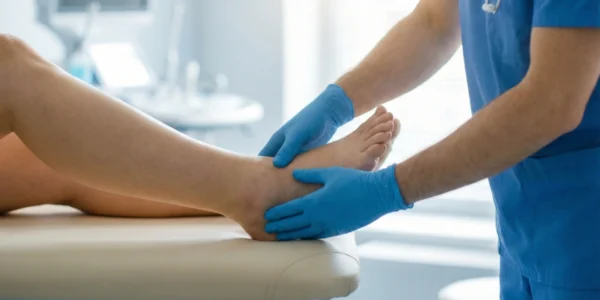
Anatomy of the Injury: Understanding the Mechanism
The ankle is held together by three main ligament complexes. Knowing exactly what was damaged determines the technology used for your leg sprain treatment.
1. The Lateral Complex (Outer Side)
This is the most vulnerable area. During an “inversion” (when you rolled your ankle inward), the following are usually affected:
-
ATFL (Anterior Talofibular Ligament): The weakest and most commonly injured (85% of cases).
-
CFL (Calcaneofibular Ligament): Provides stability when the foot is in a neutral position.
2. The Syndesmosis (High Sprain)
A high sprain involves the ligaments connecting the tibia and fibula. This injury is deceptive because it often requires twice as much recovery time and specific stabilization to prevent long-term damage.
Identifying the Problem: Signs of a Sprained Ankle
When a patient says, “I twisted my ankle,” doctors look for specific clinical markers to determine the grade of the injury:
-
Grade I (Mild): Micro-tears, minimal swelling, ability to bear weight.
-
Grade II (Moderate): Partial tear, significant bruising, and difficulty walking.
-
Grade III (Severe): Complete rupture, intense pain, and total joint instability.
Common signs of a sprained ankle include localized swelling around the ankle bone sprain area and visible bruising. If you heard a “pop” or “snap” during the injury, it often indicates a serious tear.
When is an X-ray Necessary?
In the US, we use the Ottawa Ankle Rules to avoid unnecessary radiation. A scan is required if:
-
There is bone tenderness at the back edge of the ankle bone (malleolus).
-
There is pain at the base of the pinky toe (5th metatarsal) or the navicular bone.
-
The patient is unable to take four steps immediately after the injury.
Immediate Care: Rolled Ankle What to Do
If you are wondering rolled ankle what to do in the first few hours, modern sports medicine recommends the POLICE protocol:
-
P (Protection): Using a brace or splint.
-
OL (Optimal Loading): Early, pain-free movement to help ligaments heal correctly.
-
I (Ice): 15–20 minutes every few hours for the first 48 hours.
-
C (Compression): Elastic bandages to move fluid away.
-
E (Elevation): Keeping the foot above the heart.
While many people search for home remedies for a sprained ankle, such as salt soaks or cold packs, these are only for comfort. They do not provide the structural care for a sprained foot needed to prevent future issues.

High-Tech Recovery: Advanced Medicine for a Twisted Ankle
Modern podiatry offers solutions that go far beyond standard medicine for a twisted ankle.
1. Remy Laser Pain Treatment: Healing Without Pills
This high-class laser stimulates the mitochondria in your cells, accelerating tissue repair. It effectively “turns off” pain and flushes out swelling, allowing you to heal faster without relying on systemic painkillers that can irritate the stomach.
2. Platinum Biologics: The ``Heavy Artillery``
For severe tears, we use regenerative medicine. Platinum Biologics (like PRP therapy or growth factors) helps rebuild the ligament’s structure on a cellular level. This is a game-changer for active individuals who need to get back to their feet quickly.
3. Foot Orthotics: Stabilization and Prevention
Custom Foot Orthotics are a critical part of care for a sprained foot. After an injury, ligaments can become “loose.” Orthotics stabilize the foot, correct your gait, and remove excessive stress from the healing tissues to prevent another rolled ankle.
4. Foot and Ankle Surgery: The Last Resort
If the joint remains unstable after months of rehab, Foot and Ankle Surgery (like the Brostrom-Gould procedure) is used to anatomically tighten and repair the ligaments.
The Three Phases of Rehabilitation
-
Phase 1 (Week 1): Protection and swelling control using Remy Laser.
-
Phase 2 (Weeks 2–3): Restoring strength using resistance bands (Theraband).
-
Phase 3 (Week 4+): Proprioception. This is the most ignored step. You must retrain your brain to “feel” the joint’s position using balance boards or BOSU balls.
Summary
Effective leg sprain treatment in the USA today focuses on aggressive but controlled recovery. By combining Remy Laser for pain, Platinum Biologics for healing, and Foot Orthotics for support, you can ensure your ankle is just as strong—if not stronger—than it was before the injury.
Frequently Asked Questions
Should I use ice or heat on a sprained ankle?
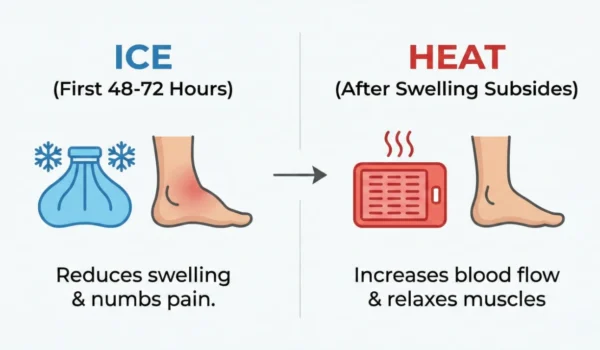
How long does it take for a sprained ankle to heal?
When should I see a doctor for a sprained ankle?
You should seek medical attention if you heard a “pop,” if the ankle is severely bruised, if there is “pitting edema” (swelling you can press into), or if you cannot bear any weight on the foot.
Does a sprained ankle need a boot or crutches?
If you cannot bear weight, a walking boot or crutches may be necessary to protect the ligaments from further tearing. A podiatrist can determine the best “Optimal Loading” plan for your specific grade of injury.
Why is my sprained ankle itchy or turning purple?
Purplish bruising is common as blood from torn tissues settles. Itchiness is often a sign of healing as the skin stretches or as nerves begin to recover. However, persistent numbness should be checked by a professional.
Can I exercise with a sprained ankle?
In the early stages, you should stick to non-weight-bearing “cardio” like a stationary bike or swimming. Avoid high-impact sports like basketball or running until you have passed a proprioception (balance) test.