

Bunion surgery recovery takes longer than most people expect: roughly six to 12 weeks for the bones to heal, about three months before usual activity, and swelling that can last well past that.
Those are not worst-case numbers. Cleveland Clinic puts bone healing at six to 12 weeks, a return to usual physical activities at around three months, and swelling that may continue for six to nine months after surgery. Knowing that in advance is the difference between a recovery that feels slow and one that feels like something went wrong.
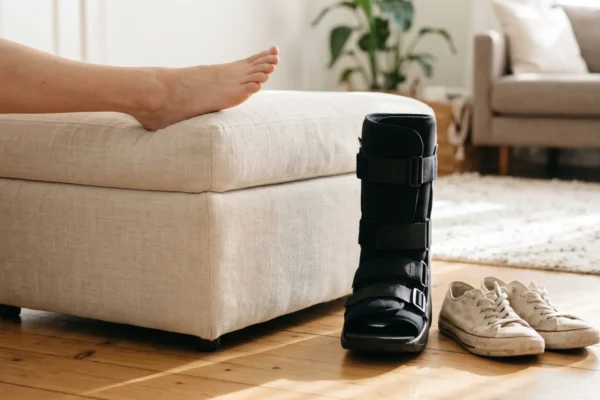
How Long Does Bunion Surgery Recovery Actually Take?
The First Two Weeks
Six to Twelve Weeks
Three Months and Beyond
| Stage | What Usually Happens |
|---|---|
| Day of surgery | Outpatient in most cases, usually an hour or less, and no driving yourself home |
| First two weeks | Protective shoe or boot; stitches that are not absorbable come out around two weeks |
| Six to 12 weeks | Bones finish healing; crutches or a knee scooter may be needed for part of this time |
| Around three months | Usual physical activities resume, often with physical therapy for strength and motion |
| Three to six months | Full recovery for most people, with sources putting the range at three to five or up to six months |
| Six to nine months | Swelling can still come and go, especially at the end of a long day |
The ranges differ a little between sources, which is itself worth knowing. Cleveland Clinic describes a few months to recover with swelling up to nine months, MedlinePlus puts full recovery at three to five months, and Mayo Clinic says it often takes up to six. Your own timeline depends on the procedure and the foot.
Why Does the Swelling Last So Long?
Swelling that comes and goes for six to nine months is within the normal range after bunion correction, according to Cleveland Clinic’s guidance. It usually looks worse in the evening, after a long day on your feet, and better in the morning.
Practically, this is the part that catches people out. Shoes that fit at four months may not fit at the end of a workday, and the foot can look wider than the before-and-after photos suggest for most of the first year.
Do You Really Need Bunion Surgery?
Mayo Clinic’s guidance is direct about it: surgery is recommended only when a bunion causes frequent pain or limits your daily activities, and usually is not done to improve how the foot looks. Its treatment advice starts with roomier shoes, non-medicated bunion pads, padded or prescription shoe inserts, and ice after long days on your feet. Surgery enters the conversation when those stop working.
A useful self-check is what the bunion costs you on an ordinary day. Pain most days, pain in every shoe you own, a toe drifting across its neighbor, or activities you have quietly dropped are reasons to be evaluated. A bump that bothers you in sandals is not.
Family history is often part of the picture, since what gets inherited is the foot structure rather than the bump itself. Whether foot problems like hammertoes and bunions run in families explains how that works, and why foot pain differs in women covers why bunions show up more often there.
Is Minimally Invasive or Lapiplasty Surgery Better?
Minimally invasive osteotomy, done through smaller cuts, is becoming more common and is associated with less scarring and a faster early recovery. Lapiplasty is a brand name for one patented approach to the Lapidus fusion, which is why the surgery discussion sometimes sounds like a product comparison. The underlying operation matters more than the name on it.
Comparative data backs that up. A 2026 study in Foot & Ankle International reviewed 140 patients who had a modified Lapidus procedure, 66 minimally invasive and 74 open, and found no statistically significant difference in patient-reported function, pain, or physical health at one year, with similar rates of nonunion, recurrence, infection, and hardware removal. Open correction achieved slightly greater angular correction; the minimally invasive group did slightly better on one measure of foot alignment.
So the honest answer to “which one” is that it depends on the severity of the deformity, the joint’s condition, and your surgeon’s experience with the technique. Choose the surgeon first.
How Often Does a Bunion Come Back After Surgery?
A 2026 multicentre cohort study in Foot & Ankle Orthopaedics followed 120 patients after minimally invasive correction and found recurrence at 12 months in 0% of mild deformities, 30% of moderate ones, and 42.5% of severe ones. The same paper notes that reported recurrence rates across the literature run from 10% to more than 30%, depending on technique, patient selection, and how recurrence is measured.
That is a reason to be evaluated earlier rather than later, not a reason to avoid surgery. A bunion corrected while the angle is still mild behaves very differently from one corrected after years of drift.
It is also why proper shoes afterward are not a cosmetic footnote. Mayo Clinic’s guidance ties keeping another bunion from forming directly to the shoes you go back to.
What Can Go Wrong, and How Common Is Regret?
MedlinePlus lists the risks of bunion removal as numbness in the big toe, a wound that heals poorly, instability or stiffness of the toe, nerve damage, persistent pain, arthritis in the toe, a worse appearance than before, bones that fail to heal after realignment, and the possibility that the surgery does not correct the problem. Cleveland Clinic adds blood clots, infection, long-term swelling from blood vessel damage, and recurrence.
Persistent pain is the one that drives the “was it worth it” question. It is an uncommon outcome rather than the usual one, but it is on the official risk list, and it is a fair thing to ask your surgeon about directly: how often it happens in their hands, and what the plan is if it happens to you.
The other common source of regret is timing. People who went in expecting to be walking normally at six weeks describe a worse experience than people who went in expecting three to six months, even when the feet ended up identical.
What Does Bunion Surgery Cost?
What moves the number:
- Which operation is done, since a fusion uses more hardware and more operating time than a simple osteotomy.
- Where it is done, as a hospital operating room and an outpatient surgery center are priced differently.
- The anesthesia plan, which varies from numbing the foot to a full general anesthetic.
- Imaging before surgery, and the follow-up X-rays that confirm the bones are healing.
- Physical therapy afterward, plus the boot, scooter, or crutches.
Insurance generally follows the same logic as the clinical guidance: correction for pain and lost function is treated as medically necessary, while surgery for appearance alone is not. Ask the office for a written estimate with the surgical, facility, and anesthesia charges listed separately, and ask what happens financially if a second procedure is ever needed.
Before and After: What a Realistic Result Looks Like
Mayo Clinic adds the detail that most disappoints people who went in for cosmetic reasons, which is that most people should not expect to wear narrower shoes after surgery. The forefoot is realigned, not shrunk.
Set against that, the usual outcome is good. Most people have noticeably less pain, better big toe alignment, easier walking, and more comfort in shoes. Measured against daily pain, that is a real change; measured against a photograph, it can feel like a letdown.
When It Is Time to Be Evaluated
Conservative care is still where a careful foot and ankle practice starts, and for many bunions it is where things stay. Dr. Arkady Kaplansky has practiced podiatry in Los Angeles since 1994 and works conservative-first, moving to surgery only when the pain and the X-rays together justify it.
That evaluation is also where the realistic version of your own timeline comes from, since it depends on which operation fits your foot. The office handles bunions alongside the rest of its foot and ankle care, including the orthotic work that often comes before or after an operation, and appointments can be booked here.
Frequently Asked Questions
How soon can I drive again after bunion surgery?
There is no single date. Driving depends on which foot was operated on, whether you can put weight through it, and what you are taking for pain. You cannot drive yourself home on the day of surgery, and some people are in crutches or a knee scooter for several weeks, so plan rides rather than a return date.
Will I need physical therapy afterward?
Many people do. Cleveland Clinic notes that physical therapy may be needed to restore strength and range of motion in the foot before usual activities resume at around three months. A stiff big toe joint responds much better to early, guided motion than to waiting.
Does smoking change how fast the bones heal?
Yes, and this is one of the few things fully under your control before surgery. MedlinePlus states plainly that smoking can slow down wound and bone healing. Since bunion correction depends on bone knitting around screws or plates, quitting ahead of the operation is worth raising at the first visit.
Will I be put to sleep for the operation?
Usually not fully. General anesthesia is often unnecessary for bunion correction; the foot or the whole leg can be numbed instead, sometimes with medicine to relax you. The anesthesia plan is decided case by case, so ask what is proposed for yours.
Can shoe inserts stop a bunion from getting worse?
They can help. Padded inserts spread pressure more evenly and may slow a bunion from progressing, and prescription orthotic devices do this more precisely than off-the-shelf supports. They do not reverse the bone position, so think of them as slowing the clock rather than turning it back.
How much time off work should I plan for?
It depends almost entirely on weight-bearing. Desk work with the foot elevated is possible far sooner than a job that keeps you standing or on ladders. Since usual physical activity generally resumes near the three-month mark, anyone on their feet all day should plan for a staged return rather than one return date.
Sources Used
Bunion Surgery (Bunionectomy) – Cleveland Clinic (2026)
Bunions – Diagnosis and treatment – Mayo Clinic (2025)
Minimally Invasive vs Open Lapidus Bunionectomy: 1-Year Patient-Reported Outcomes – Foot & Ankle International (2026)
Recurrence After Combined Minimally Invasive Transverse–Akin and Distal Minimally Invasive Metatarsal Osteotomies: Association With Preoperative Deformity Severity in a Multicentre Retrospective Cohort Study – Foot & Ankle Orthopaedics (2026)
Minimally invasive osteotomy with intramedullary plating for the correction of hallux Abducto valgus: A multicenter retrospective radiographic review – The Journal of Foot and Ankle Surgery (2026)
The modified Lapidus fusion: a systematic review of biomechanical studies – PMC (2023)