

This content is for informational purposes only and does not constitute medical advice. Please consult with a licensed podiatrist for a personalized evaluation and treatment plan. Individual results may vary.
Custom insoles are molded from your own foot. Store-bought inserts are not. That difference matters for some diagnoses and barely matters for mild, everyday aches.
The evidence is more balanced than the price gap suggests. A 2023 review in Foot & Ankle Orthopaedics comparing custom and prescription-grade prefabricated foot orthoses looked at 238 patients and found both groups improved significantly in pain and function, with satisfaction scoring 8.1 for custom against 7.5 for prefabricated. Custom came out ahead on physical function, and not on everything else.
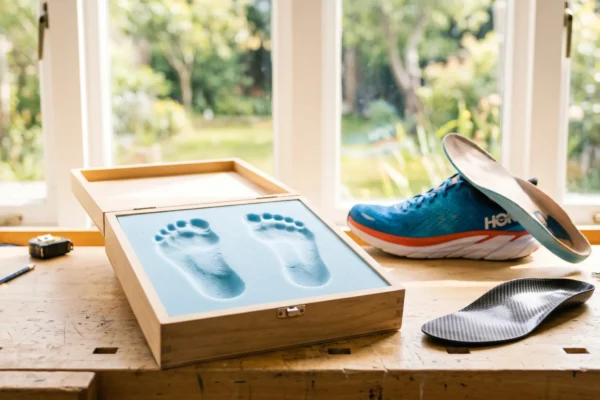
What Is the Difference Between Custom Insoles and Store-Bought Inserts?
Custom devices are also split into two families. Functional orthotics are semi-rigid, often graphite or carbon fiber, and are built to control how the foot moves. Accommodative orthotics are soft and flexible, built to take pressure off a painful or at-risk spot. A drugstore insert is closest to the second one, in a generic shape.
Side by side, the practical differences line up like this.
| What to compare | Over-the-counter inserts | Custom insoles |
|---|---|---|
| How it is made | Standard sizes picked off a shelf | A plaster mold, a foam impression box or a 3D scan of your foot |
| Who decides the design | You do, from the packaging | A provider does, from an exam and a diagnosis |
| Cost up front | Lower | Much higher |
| How long it lasts | Shorter | Lasts much longer with better cushioning and support |
| Insurance | Usually paid out of pocket | Variably covered |
Why Do Custom Orthotics Cost So Much More?
What the research says plainly is that the gap is large and the benefit is not guaranteed. The authors of that 2023 comparison noted custom devices carry a much higher cost, are variably covered by insurance, and showed no definitive superiority over prescription-grade prefabricated devices in their data.
That does not make custom orthotics a bad purchase. It makes them a targeted one. The question worth asking in the exam room is narrow: what specifically about this foot cannot be handled by a generic shape?
Does Insurance or Medicare Cover Custom Orthotics?
The same CMS page shows where these claims break down. It reports a 47.1% improper payment rate for therapeutic footwear in 2024, with insufficient documentation accounting for 85.5% of improper payments. It also requires that the certifying physician saw the patient in person within six months before delivery.
Outside that diabetes-related benefit, coverage depends entirely on the plan and is often absent. The useful move is to call the number on the insurance card and ask about foot orthoses before the device is ordered, because asking afterwards changes nothing.
Which Foot Problems Really Need Custom Orthotics?
Flat Feet and Fallen Arches
Inherited foot shape is worth mentioning at a visit, because it changes how long a generic insert is likely to hold up. Do Foot Problems Like Hammertoes Run in Families? covers which foot traits tend to pass down and what that means for support.
Morton's Neuroma
Diabetes and High-Risk Feet
When Are Over-the-Counter Arch Supports Good Enough?
What the Trial Evidence Shows
That trial also found its own limit. In one specific foot shape the effect disappeared entirely, which is exactly the situation where a generic device stops being enough and a measured one begins to earn its price.
A Reasonable First Trial
If the pain is months old, or the foot itself is changing shape, that trial has effectively already been run. Foot Arch Pain: Why the Middle of Your Foot Hurts goes through the causes behind midfoot pain, which is what sends most people to the insert aisle to begin with.
How Can You Tell a Device Is Truly Custom?
The usual point of confusion is the pharmacy or mall pressure mat. You stand on a pad, a screen shows a colored heat map, and you are handed one of a dozen pre-made trays. That is a fitting, not a prescription. It can still help, and it costs a fraction of the price, but it is a different object.
Three questions settle it. Was an impression of my foot taken, and how? Is a diagnosis written on the prescription? And who adjusts the device if it hurts in week two? A prescribed orthotic comes with that last answer built in.
What Happens at a Visit for Custom Fit Orthotics?
Dr. Arkady Kaplansky has practiced in Los Angeles since 1994 and works conservative-first, which in practice means footwear, mechanics and a device before anything invasive is discussed. The practice’s foot and ankle services cover custom orthotics alongside flat feet, arch pain and plantar fasciitis care.
If the pain sits under the ball of the foot rather than the arch, Pain in the Ball of the Foot covers what that pattern usually points to and why padding placement matters there. When you are ready, you can book an appointment.
Frequently Asked Questions
How long does a pair of custom orthotics usually last?
Years, in most cases, though it depends on the materials, how active you are and whether your weight changes. Soft accommodative devices wear out faster than semi-rigid ones. The shell often outlives the top cover, which can be replaced on its own.
Will one pair work in all my shoes?
Often not. A full-length orthotic needs a shoe with a removable insole and enough depth, which rules out most dress shoes and sandals. Many people end up with one pair for athletic shoes and a thinner device for work shoes.
Is there a break-in period, and what if they hurt?
Some adjustment is normal, and most providers suggest building up wear time rather than going straight to a full day. Pain that keeps getting worse is a reason to go back for an adjustment, not a reason to stop wearing them without saying anything.
Are 3D-printed orthotics the same as traditionally molded ones?
Not automatically. Both can be custom, but the fabrication method and the material affect comfort and how much people actually wear the device. It is a fair question to ask about how yours will be made.
Do children with flat feet need custom insoles?
Flat feet are common in children and are frequently flexible and painless, in which case no device is needed. That call belongs to an exam rather than a shoe store, especially if there is pain or the child avoids activity.
Can I reuse an old pair, or a pair made for a relative?
A device made from someone else’s foot impression is not custom for yours. An old pair may also no longer match your foot after years, a weight change or surgery, which is worth checking before relying on it again.
Sources Used
Comparing the Utility of Custom Foot Orthoses vs Prescription-grade Prefabricated Foot Orthoses – Foot & Ankle Orthopaedics (2023)
Comprehensive Foot & Ankle Care for Adults & Seniors – Arkady Kaplansky, DPM
Do Foot Problems Like Hammertoes Run in Families? – Arkady Kaplansky, DPM
Easy, Secure, and Convenient Care Starts Here – Arkady Kaplansky, DPM
Flatfeet – Mayo Clinic (2026)
Foot Arch Pain: Why the Middle of Your Foot Hurts – Arkady Kaplansky, DPM
Morton’s Neuroma – Cleveland Clinic (2023)
Orthotics – Cleveland Clinic (2024)
Pain in the Ball of the Foot: Common Causes – Arkady Kaplansky, DPM
The Influence of Prefabricated Foot Orthosis Use on the Modification of Foot Posture in Adults with Pronated Feet: A Randomised Controlled Trial – Healthcare (2025)
Therapeutic Footwear – Centers for Medicare & Medicaid Services (2026)
Healthcare Provider Knowledge and Utilization of the Medicare Therapeutic Shoe Benefit – Journal of the American Podiatric Medical Association