

This content is for informational purposes only and does not constitute medical advice. Please consult with a licensed podiatrist for a personalized evaluation and treatment plan. Individual results may vary.
Barefoot shoes can strengthen a foot. They can also injure one. Which happens depends on the arch you start with and how fast you make the switch.
The research points both ways because it answers two different questions. Studies that measure foot muscles in healthy adults find real gains. Studies that follow runners through the switch find a clear rise in injuries. Both results hold, and what separates them is the pace of the change and the foot it happens to.
What Are Barefoot and Minimalist Shoes?
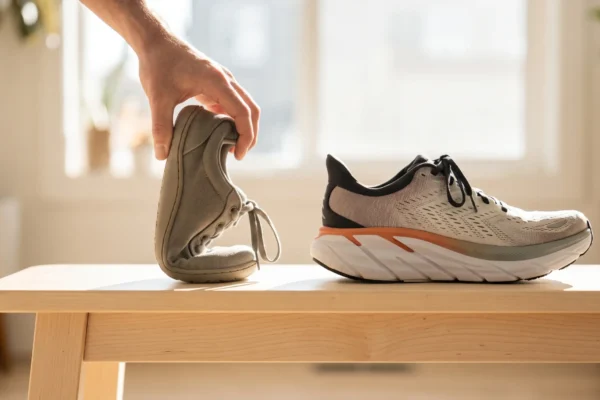
Two terms do most of the work. Drop is the height difference between heel and forefoot, and a zero drop shoe has none, so the foot sits level. Stack height is how much material sits under the foot, and in a true minimalist shoe that is a few millimetres rather than a few centimetres.
Marketing blurs the category. A cushioned running shoe with a roomy forefoot gets sold as barefoot-inspired, and a thin-soled fashion sneaker gets sold as minimalist. Pick the shoe up and bend it. If the sole folds easily in both directions and the heel sits level with the toes, the label is accurate.
Do Barefoot Shoes Actually Strengthen Your Feet?
A randomised controlled trial published in PLoS One (2024) followed 28 recreationally active adults through a four-week minimalist walking programme that began at 3,000 steps a day and rose to 5,000. Foot posture scores and single-leg balance both improved significantly, and those gains were still measurable after four weeks back in ordinary shoes.
A systematic review in the Journal of Clinical Medicine (2025) pooled seven studies covering 213 participants. Most of the interventions produced measurable increases in foot muscle volume, medial arch function, toe flexor strength and neuromuscular control, with the clearest results where strength, balance and agility work ran together over several weeks.
What the Research Does Not Say
Who Should Not Wear Barefoot Shoes?
Flat Feet and Overpronation
Numb Feet and Fragile Skin
Feet That Already Hurt
Structure runs in families too, and a foot shape inherited from a parent is not something a shoe redesigns. If bunions, hammertoes or flat feet run through your family, that history is worth weighing before buying.
What Are the Risks of Switching Too Fast?
A systematic review and meta-analysis in Gait and Posture (2026) looked at 12 studies, pooled seven of them covering 313 runners, and found the transition to minimalist footwear carried a moderate increase in injury risk, with an overall effect size of 3.529 (95 percent CI 2.41 to 4.646). The injuries reported most often were bone marrow edema in the metatarsal region, Achilles tendinopathy and calf pain, all tied to the shift toward a forefoot strike.
Bone marrow edema is the stage before a crack. Cleveland Clinic (2023) defines a stress fracture as a small crack in a bone and estimates that stress fractures account for around 20 percent of all sports injuries. The pain starts during activity, gets worse as the activity continues, and stays tender when pressed.
Signs the Shoes Are Not Working
How Do You Transition to Barefoot Shoes Safely?
Walking comes before running. The walking trial described earlier used 3,000 steps a day in week one and 5,000 for the three weeks after, and that is a sensible template for anyone starting out. Everything around those numbers is ordinary caution rather than a protocol.
A Conservative Twelve-Week Ramp
| Stage | What to Do | What to Watch For |
|---|---|---|
| Weeks 1 to 2 | Wear them indoors only, under an hour a day | Calf and Achilles tightness the next morning |
| Weeks 3 to 4 | Short walks outdoors, around 3,000 steps a day | Soreness that should settle overnight |
| Weeks 5 to 8 | Build gradually toward 5,000 steps a day | Any ache under the ball of the foot |
| Weeks 9 to 12 | Longer walks and daily wear if nothing hurts | Pinpoint tenderness over a single bone |
| After 12 weeks | Add running only if walking stayed pain-free | Achilles or calf pain in the hours after a run |
Two habits make the ramp easier. Keep your old shoes in rotation through the whole period so no single day is spent entirely in the new pair. And stretch the calves daily, because lowering the heel asks the calf and Achilles to work through a longer range than they are used to.
Do Wide Toe Box Shoes Help Even Without Going Minimalist?
Width solves a separate problem from drop and cushioning. A toe box narrower than the foot squeezes the forefoot inward, which is the mechanical story behind many bunions and hammertoes. A wider toe box can be paired with normal cushioning and normal arch support, so nothing has to be given up.
Fit is worth doing properly. Measure both feet late in the day when they are at their largest, stand up in the shoe rather than sitting, and check that the widest part of the shoe sits where the widest part of your foot does. Toes should be able to spread without touching the sides.
Barefoot Shoes vs Arch Support: Where Does the Truth Sit?
Support reduces load on a structure that cannot hold itself up. Minimalism trains a structure that can. A foot with a functioning arch has something to train, and a foot whose arch has collapsed does not, which is why the same advice cannot cover both. The question of whether an insole is worth the money turns on the same distinction.
The pseudoscience sits in the promises, not the shoes. Claims that minimalist footwear corrects posture, cures plantar fasciitis or ends back pain run well past what has been measured. What the studies actually recorded was muscle volume, arch function, toe strength and balance.
Where Pain Changes the Answer
Where a Podiatrist Fits Into a Footwear Change
That assessment is straightforward. Arch height standing and sitting, how far the ankle bends, where the callus pattern sits on the sole, how the foot behaves on a single-leg rise, and whether old injuries left stiffness behind. Dr. Arkady Kaplansky has run a private practice in Los Angeles since 1994 and works conservative options first, which in this case usually means adjusting the plan rather than banning the shoes.
The same exam covers the problems that sit underneath a footwear question, including flat feet, forefoot pain, heel pain and sports injuries. A look at the range of foot and ankle care shows where a footwear question usually leads.
Booking the Exam Before the Shoes
Frequently Asked Questions
Why are some podiatrists cautious about barefoot shoes?
Because they see the failures rather than the successes. A patient who switched well never books an appointment. The ones who arrive have usually gone from a cushioned trainer to a zero drop shoe inside a week, and the foot never got the months it needed.
Can children wear barefoot shoes?
Children’s feet are flexible by design, and a flat-looking arch is normal in early childhood. A soft, wide, flexible shoe suits most growing feet. If a child complains of pain, trips often or walks oddly, that deserves an exam rather than a shoe change.
Are barefoot shoes a good idea if you stand all day at work?
Usually not as a first step. Eight hours on hard floors loads the heel and forefoot without the movement that builds strength. Many people do better in a supportive shoe at work and keep minimalist shoes for walking.
Can you wear orthotics inside barefoot shoes?
Rarely in any useful way. Most minimalist shoes have no depth for a device and no structure to hold one in place, and adding arch support cancels the point of the shoe. If you need an orthotic, the shoe has to be built to take it.
How can you tell whether your arch is strong enough to try them?
One simple check is standing on one leg and rising onto the ball of the foot without the arch rolling inward or the ankle wobbling. It is not a diagnosis, but struggling with it suggests the foot is not ready yet.
Do minimalist shoes wear out faster than regular shoes?
The thin outsole has less rubber to lose, so the tread often disappears sooner. Check the sole at the ball and the heel for wear-through, because a worn thin sole leaves almost nothing between the foot and the pavement.
Sources Used
Effects of Barefoot and Minimalist Footwear Strength-Oriented Training on Foot Structure and Function in Athletic Populations: A Systematic Review – Journal of Clinical Medicine, PubMed Central (2025)
Flat Feet (Pes Planus) – Cleveland Clinic (2024)
Injury risk associated with the transition to minimalist footwear in runners: A systematic review and meta-analysis – Gait and Posture, PubMed (2026)
Metatarsalgia – Cleveland Clinic (2023)
Stress Fractures – Cleveland Clinic (2023)
Barefoot and minimal shoes may increase injury risk in young runners | College of Health – Oregon State University (2024)
Effects of Sports Shoe Drop on Walking Biomechanics: A Cross-Sectional Observational Dynamometric Study – Applied Sciences (2025)
Shoe Stack Height: What It Is and Why It Matters – WikiShoes (2026)