

Table of Contents
It depends on the floor and on your feet. Barefoot time is fine for many healthy feet on forgiving surfaces. Hard floors and existing pain change the answer.
Whether walking barefoot is bad for your feet comes down to how much shock your arch has to absorb and how much feeling you have in your skin. Cleveland Clinic (2024) describes the arches of the foot as a springboard and shock absorber that store and release energy as you walk and adapt the foot to uneven ground.
What Happens to Your Feet When You Walk Barefoot?
On Grass, Sand, and Carpet
On Tile, Hardwood, and Concrete
Is Walking Barefoot on Hard Floors Bad for Plantar Fasciitis?
Barefoot hours at home tend to be the part patients forget to mention. Someone may wear good shoes all day at work, then spend four hours on kitchen tile with nothing on their feet, which is often where the next morning’s heel pain comes from.
The timing of the pain tells you a lot about what is happening. Morning heel pain and evening heel pain point toward different treatment, which is covered in the timing of heel pain and plantar fasciitis.
Does Arch Support Weaken Your Foot Muscles?
Support is a treatment with a purpose. Cleveland Clinic guidance on orthotics (2024) frames shoe inserts and custom devices as ways to relieve pain from conditions such as flat feet, high arches, bunions, hammertoes, forefoot pain, and Morton’s neuroma, and notes they can help prevent or delay more invasive treatment like surgery.
The sensible position sits between the two camps. Feet that are strong and pain free do not need a prescription insert to stay that way, and feet that already hurt rarely get better by removing the only thing taking pressure off them.
If you are weighing a drugstore insert against a custom one, the differences are practical rather than philosophical, and custom insoles versus store-bought inserts lays those out.
Is Going Barefoot Better or Worse for Flat Feet and High Arches?
Flat Feet and Fallen Arches
Flat feet that developed later are a different matter. Aging, injury, or illness can damage the tendons that hold the arch, sometimes on one side only, and a collapsing arch that has started to ache is not the foot to go without support.
High Arches
Pain in the middle of the foot is often where this shows up first, and what causes foot arch pain goes through the usual reasons the midfoot starts to hurt.
Arch type is easier to picture side by side:
| Arch Type | What It Looks Like | Why It Matters in Bare Feet |
|---|---|---|
| Flat (pes planus) | Little or no arch in the sole; may be lifelong or may develop after an injury or illness | Arch problems raise the risk of plantar fasciitis, so long unsupported standing is less forgiving |
| Normal | The arch rests slightly raised and flexes as you walk | Acts as a springboard and shock absorber, so short barefoot time on soft ground is usually fine |
| High (pes cavus) | The arch never flattens, even under body weight; a footprint shows no middle section | A high instep shifts more stress onto other parts of the foot, which can cause discomfort or injury |
Most people can place themselves with a wet footprint on a dry floor, though a footprint only suggests the shape. An exam is what tells you whether the arch is flexible, rigid, or changing.
Do Barefoot Shoes Do the Same Thing as Going Barefoot?
The footwear question has its own answer, including how fast a switch is safe and who should not make it. Whether barefoot and minimalist shoes are good or bad for your feet covers the transition in detail.
One point carries over to both. Any sudden change in how much support your feet get, in either direction, is what tends to produce new pain, which is why gradual is the only sensible way to change a habit of years.
Who Should Not Go Barefoot at All?
According to the CDC (2024), about half of all people with diabetes have some kind of nerve damage, and the nerves in the feet and legs are affected most often. The same CDC guidance on feet and diabetes says plainly: never go barefoot, and wear shoes and socks or slippers even inside to avoid injury.
The reason is simple and worth saying out loud. A cut, a splinter, or a burn that you cannot feel goes unnoticed and untreated, and a small wound on a foot with reduced circulation is far harder to heal than the same wound anywhere else.
A few other situations call for covered feet:
- Reduced sensation in the feet from any cause, not only diabetes
- An open sore, a healing wound, or recent foot surgery
- Shared wet floors such as gyms, pools, and locker rooms, where fungal infection spreads
- Any foot or heel pain that is already present and gets worse by the end of the day
Should You Wear Slippers or Shoes in the House?
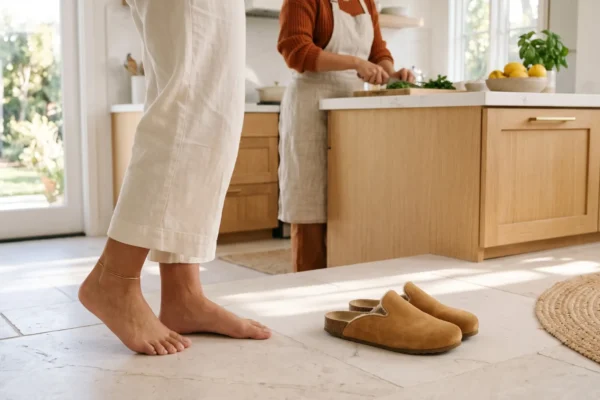
Thin flat slippers do less than people assume. A flexible scuff with no sole structure is closer to bare feet than to a supportive shoe, so it does not change much if hard flooring is already bothering your arches.
A practical middle path works for most households. Keep bare feet for carpet, rugs, grass, and short stretches, and reach for an indoor shoe for the hours spent standing on tile or hardwood in the kitchen.
What Does a Foot Exam Add Before You Change Anything?
Pain that has lasted more than a few weeks is the usual reason to get it looked at rather than experiment further. Dr. Arkady Kaplansky treats foot and ankle problems from the Hollywood office on Sunset Blvd, with conservative options tried first and surgery considered only when they fall short.
If bare feet on hard floors have been leaving your arches or heels sore, an exam is a short appointment with a clear outcome. Book a visit and bring the shoes and slippers you actually wear at home, because those tell the story faster than any description.
Frequently Asked Questions
Does walking barefoot on grass have any real benefit?
Soft, uneven ground lets the arch flex through its full range, which is harder to do inside a stiff shoe. Short walks on clean grass or sand are a reasonable way to move the foot through that range. Check the ground first, since the main risk outdoors is what you step on.
Can bare feet cause bunions or hammertoes?
Those changes are driven mostly by foot structure and by how a shoe squeezes the front of the foot, not by being barefoot. Narrow, pointed, or high-heeled shoes have more to do with it. Having bare feet at home neither causes them nor corrects them.
Why do my feet hurt more in summer when I am barefoot or in sandals?
Both tend to mean less structure under the arch for more hours of the day. Flat sandals and bare feet shift work back onto the plantar fascia and the small foot muscles. The ache usually settles once some support comes back into the daily routine.
Is it bad for children to be barefoot at home?
For healthy children, barefoot play indoors is generally fine and is part of how the foot develops. Arches form through the toddler years, so flat-looking feet in a small child are usually normal. Pain, limping, or a child who refuses to walk deserves an exam.
Do calluses mean I have been barefoot too much?
A callus marks where pressure is concentrated, so it is more a map than a verdict. Thick skin under the ball of the foot or along the arch edge suggests load is landing unevenly. That pattern is worth showing to a podiatrist rather than filing down and ignoring.
How long does it take for feet to adjust to less support?
Longer than most people expect, and it should be measured in months rather than days. Tissue adapts slowly, and the usual mistake is adding too much barefoot time in one week. New pain during a change is the signal to scale back, not to push through.
Sources Used
- Flat feet – MedlinePlus Medical Encyclopedia (2025)
- Flat Feet (Pes Planus) – Cleveland Clinic (2024)
- High Arch Feet (Pes Cavus) – Cleveland Clinic (2024)
- Orthotics – Cleveland Clinic (2024)
- Plantar fasciitis – MedlinePlus Medical Encyclopedia (2026)
- Your Feet and Diabetes – Centers for Disease Control and Prevention (2024)
- Morton neuroma – Symptoms and causes – Mayo Clinic (2025)